
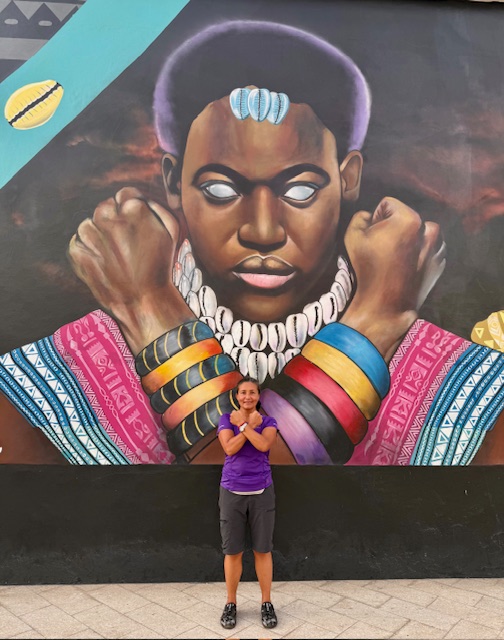
“Our telling of history needs to change, and our society needs to change.”
These words, spoken by Sonia Gutiérrez of the Poqomam Maya people, have stayed with me.
They remind me why I am so grateful for researchers, writers and people who dare to look at history again — not through the eyes of those who conquered, but by listening to those whose voices were silenced.
For centuries, cultures such as the Maya were described as mysterious, primitive, barbaric or even lost. Yet the Maya developed sophisticated writing and mathematical systems, studied the movements of celestial bodies with remarkable precision, and built magnificent cities such as Tikal and Copán, long before Europeans arrived in the Americas.
And then came #conquest.
History has a way of making such losses sound inevitable. They were not.
In the 16th century, Spanish colonisation brought forced labour, religious persecution and epidemics that devastated Maya communities. Sacred knowledge was destroyed. In 1562, Bishop Diego de Landa ordered the burning of Maya books, believing them to contain dangerous superstition. Only four pre-Columbian Maya codices are known to have survived. Imagine the knowledge that disappeared into those flames! The stories, the prayers, the observations of the stars, the memory of a people — reduced to ashes by those who believed they had the authority to decide what was worth preserving.
It is often said that history is written by the victors. And too often, those who were conquered had to be diminished before their suffering could be justified. Their cultures were called inferior, their beliefs dismissed, their humanity questioned.
After travelling in West Africa — and especially in Benin — I found myself thinking about this again, through the history of the transatlantic slave trade.
Between the 16th and 19th centuries, an estimated 12.5 million African men, women and children were forcibly embarked on slave ships bound for the Americas. Around 10.7 million survived the crossing. These were not simply numbers in a statistical record. They were human beings, torn from their families, their languages, their communities and the landscapes that had shaped their lives.
Enslaved people were forced to labour in plantations, mines and households, generating wealth that helped shape economies on both sides of the Atlantic. The trade was sustained by a vast economic system involving European empires, merchants and plantation owners, as well as African states and intermediaries who participated in the capture and sale of people. Its consequences reached far beyond the shores of Africa and… Madagascar!
Here, the history came unexpectedly closer to home.
In my own search, I began to discover traces of Malagasy people among the enslaved populations of Louisiana. People taken from an island that is a part of my own story, carried across oceans into a world that was not theirs by choice. Their names, their lives, their descendants — some traces remain, scattered across archives and generations. Others may have disappeared into the silences of history.
For me, this discovery made the history of slavery feel unexpectedly intimate. Madagascar was no longer only the place I had left behind. It was also part of a story carried across the Atlantic, a story whose echoes may still be heard in Louisiana today. I found myself wondering what survived the brutal crossing. Words, customs, a memory passed quietly from one generation to the next? And how much of a person’s identity can be taken away before some resilience still finds a way to endure?
In places such as Ouidah, in present-day Benin, the past is still written into the landscape. The Route of the Slave leads towards the Atlantic, tracing the final steps of people who were imprisoned, sold and forced aboard ships. Today, the Door of No Return stands as a memorial to those who left under such terrible circumstances — and to the families and descendants whose histories were forever altered.
In Ghana, standing at Assin Manso, a place connected to the inland slave trade, I felt the distance between past and present grow strangely thin. History no longer seemed safely contained in books or museums. It was there, beneath my feet. And I began to understand that remembering is not simply an act of looking backwards. It is also a way of seeing the present more clearly. Because the legacy of slavery did not end when the ships stopped sailing. It lives on in patterns of inequality, in racial prejudice, in the stories societies choose to tell — and in the stories the conquerors continue to leave out.
Yet these histories are not only stories of suffering. They are also stories of resistance, survival, creativity and extraordinary human resilience. The people who endured enslavement were never merely victims of history. They were individuals with names, dreams, knowledge, beliefs and lives that mattered. Their descendants continue to carry, reshape and reclaim that inheritance.
Perhaps this is what moves me most when I travel: the possibility of looking beyond the familiar version of a story. Of standing in a place and allowing its silences to speak. Of recognising that what we call a new land may have been someone else’s home for thousands of years. That what we call a lost civilisation may simply be a civilisation whose story we have failed to hear and tell.
Changing how we tell history is not about inheriting guilt for the actions of those who came before us. It is about accepting the responsibility to look honestly, to listen more carefully, and to restore dignity where it has been denied.
It is about understanding that civilisations were not simply discovered — they were often disrupted. That enslaved people were not workers who happened to migrate — they were human beings stolen from their lives. That knowledge was not always lost to time — sometimes, it was deliberately destroyed.
And perhaps, when we turn our heads — and our hearts! — back in time, something begins to shift.
The ruins become more than stones.
The names become more than dates.
The people who once seemed distant become familiar, human.
People who loved, feared, hoped and dreamed, just as we do.
Perhaps that is where a different kind of future becomes possible.

