
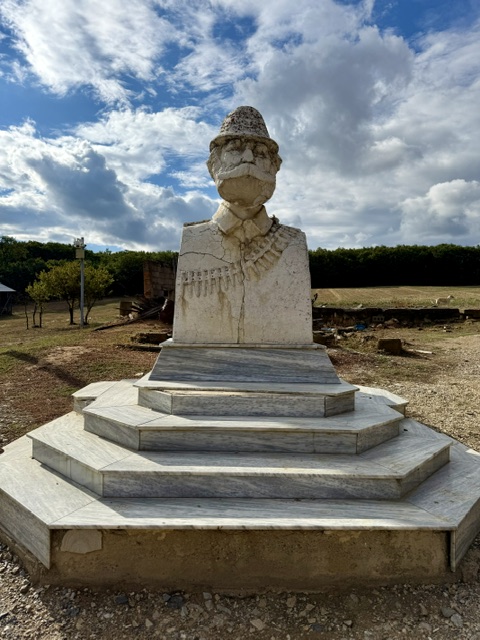
Visiting the Jashari Memorial Complex in Prekaz.
Adem Jashari has become a symbol of armed resistance and sacrifice for many Kosovo Albanians. He was a founder and commander of the Kosovo Liberation Army (UÇK/KLA), an ethnic Albanian guerrilla force that fought Serbian and Yugoslav forces during the Kosovo War (1998–1999), seeking Kosovo’s independence. It was formally disbanded in 1999. Its legacy remains deeply significant—and contested!—among Albanians and Serbs.
Listening to our guide, I understand that the Jashari family memorial in Prekaz is one of the most emotionally and politically significant places in Kosovo. What struck me most was the disturbing contrast:
the cemetery felt monumental and peaceful, while the bullet-scarred houses nearby made the violence painfully tangible.
Travelling through the Balkans, I find myself wondering why war and conflict seem to occupy such a large part of the story of these countries. Sitting on a stone bench outside the museum, my head started spinning:
”Why have the peoples of the Balkans fought each other so many times?”
The answer, of course, is not simple. The peoples of the Balkans have fought repeatedly over centuries — but they have also lived together for centuries.
Perhaps that is the fascinating part to remember while travelling here: a place can have been Ottoman, Serbian, Albanian, Yugoslav — and something else again — without its history ever belonging neatly to just one identity?
People have shared these lands, cities, markets, languages, food and traditions for generations, despite their differences.
So why did that coexistence sometimes break down so catastrophically?
I feel in my heart that the Balkans are so much more than their wars.
The Balkans are a rich tapestry of extraordinary food and music, Ottoman and Venetian influences, Orthodox and Catholic traditions, mosques and churches, mountains and rivers, ancient cities and — above all — generations of people, cultures and traditions woven together through centuries of shared history, sometimes harmonious, sometimes marked by conflict.
And, of course, the Illyrians — ancient tribes, fierce warriors, and a legacy that still echoes through the region. Many Albanians, including Kosovo Albanians, consider themselves descendants of these ancient peoples. While the precise historical and linguistic links remain debated, Illyrian heritage continues to hold a meaningful place in Albanian identity. It is one of the many threads connecting the present to a distant, fascinating past.
I love it when the Universe (or synchronicity) gets playful. The name of our eminent guide in Prishtina was Ilir — a name rooted in ancient Illyria, and carrying the spirit of freedom. The Albanian word i lirë means “free.”
The Balkans are so much more than the conflicts that have shaped their history. They are a place of extraordinary depth, where beauty and sorrow, memory and reinvention, seem to exist side by side.
I hope to return, with more time to listen to its stories, discover its hidden corners, and understand a little more of the many layers that make this part of the world so captivating.


Gezuar, Kosovo!